Choosing an AEO or GEO agency that publishes pages, not a dashboard
A checklist for telling an AEO or GEO agency that publishes pages engines can cite from one that only ships a dashboard, plus how to verify it yourself.
Choose the agency that publishes pages on your own website, and check one sample page before you sign. Its position on a ranked list tells you very little.
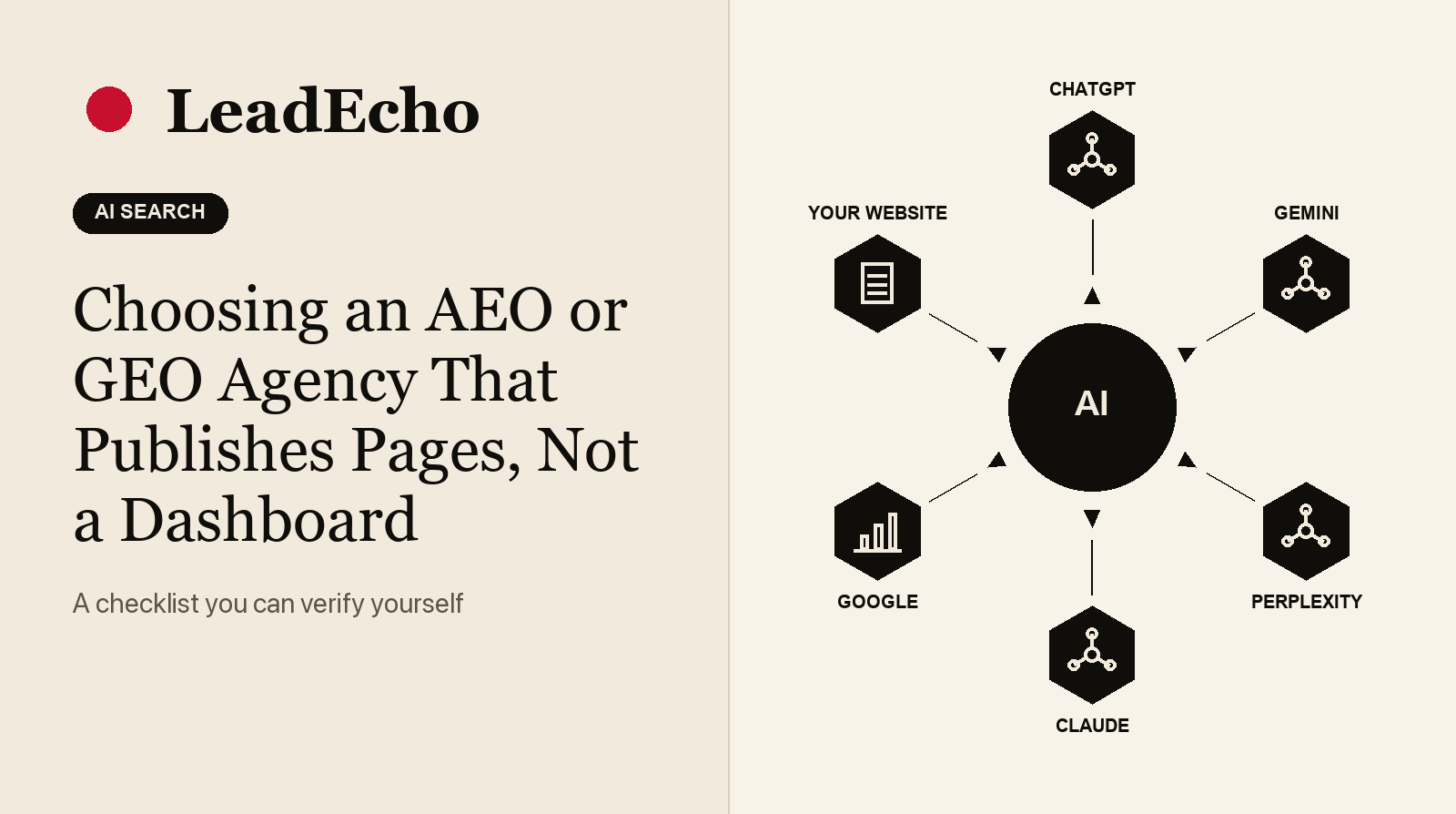
Two agencies can both promise AI visibility. One puts indexable pages on your domain that ChatGPT, Gemini and Perplexity can pull into an answer, and the other sells a dashboard that reports where you stand. You pay a retainer either way, and only one of them gives an engine something to name you from.
This guide covers why the fork decides the choice, what a page-publishing scope of work must commit to, and how to verify each answer in view-source. It also covers where a dashboard still earns its place. It is written for the marketing lead or owner at a firm of about 100 people who has to pick a vendor and cannot tell the two kinds apart.
The question the ranked lists never ask
You searched for the best agency and got ranked lists. Many of them are written by agencies that sell the same service, and each list names the others.
None of them tells you how to choose. “Best” only means something once you know what you are buying, and the useful reading of it is best at publishing pages on your site, on terms you can check. Every vendor says it delivers AI visibility, and only some ship the thing an engine can name.
Picture a marketing lead at a 100-person firm who signs a retainer. Six months later she has a dashboard with clean charts showing that her competitors are named in ChatGPT answers and her firm is not. Her website has no new pages. The reports are accurate, and they change nothing.
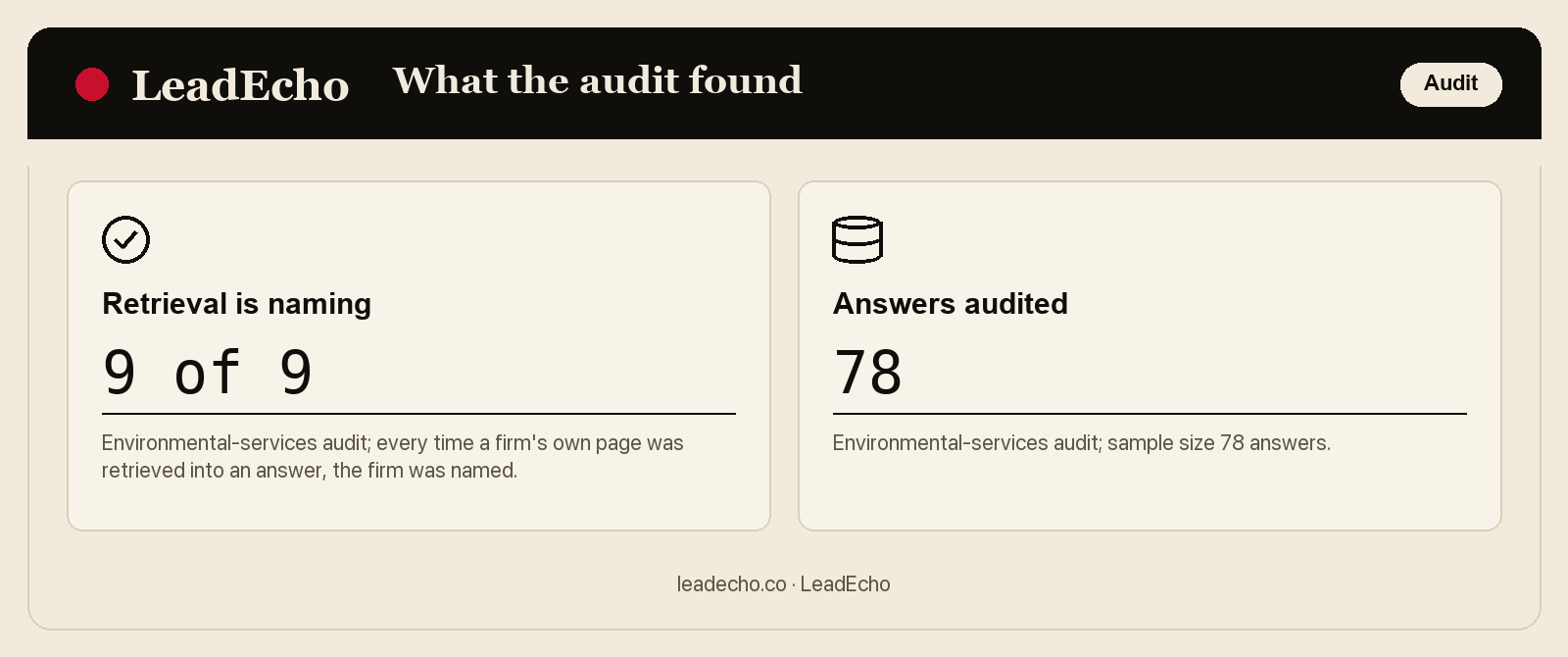
Here is why that happens. In an environmental-services audit of 78 answers, every time a firm’s own page was retrieved into an answer, the firm was named: 9 of 9. Retrieval is naming. The firm shows up because its page was pulled in.
The same audit found that case-study pages were retrieved only when someone asked about the firm by name, never when the question described the problem the firm solves. Proof that exists on the wrong side of the buyer’s search does not get you named. A dashboard is further away still, because it is not a page at all.
So what does an engine actually pull from?
Why an engine can cite a page and never a dashboard
An engine names a firm by pulling from a page that exists on the open web, so a tool that publishes nothing gives it nothing to pull. Here is the sequence. A buyer types a question, the engine runs a handful of searches, it retrieves pages, and it writes an answer from those pages, linking to them as sources (that is a citation) and naming the firms they describe.
Google’s own documentation is plain about the entry requirement. Google’s Search Central page on AI features, checked in September 2026, says a page must be indexed and eligible to show in Search with a snippet to appear as a supporting link in AI Overviews and AI Mode. It also says no special markup or schema is required.
Read that as a buyer. The requirement is plain: the page has to exist, Google has to have indexed it, and it has to be readable enough to show a snippet.
A dashboard is a thermometer. It tells you the temperature in the room and does not heat it. Nothing in its output is a page an engine can retrieve, so no amount of reporting puts your name in an answer.
That makes the agency’s real job simple to state: ship pages. The next question is what you should make it commit to in writing.
What a page-publishing agency commits to
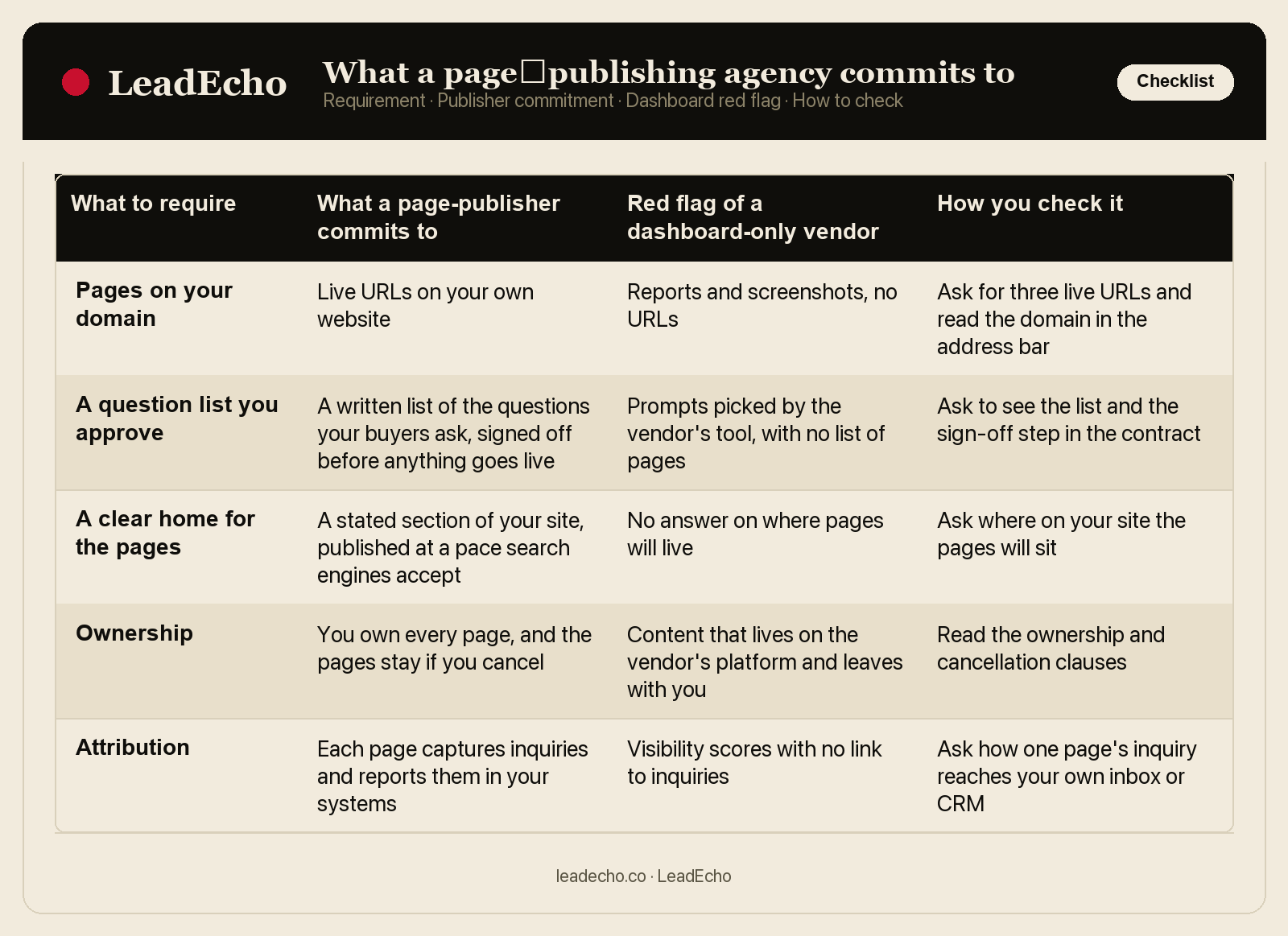
Ask for these five commitments in the scope of work. The table is organized by what you require, what a publisher commits to, what a dashboard-only vendor offers instead, and how you check it yourself.
| What to require | What a page-publisher commits to | Red flag of a dashboard-only vendor | How you check it |
|---|---|---|---|
| Pages on your domain | Live URLs on your own website | Reports and screenshots, no URLs | Ask for three live URLs and read the domain in the address bar |
| A question list you approve | A written list of the questions your buyers ask, signed off before anything goes live | Prompts picked by the vendor’s tool, with no list of pages | Ask to see the list and the sign-off step in the contract |
| A clear home for the pages | A stated section of your site, published at a pace search engines accept | No answer on where pages will live | Ask where on your site the pages will sit |
| Ownership | You own every page, and the pages stay if you cancel | Content that lives on the vendor’s platform and leaves with you | Read the ownership and cancellation clauses |
| Attribution | Each page captures inquiries and reports them in your systems | Visibility scores with no link to inquiries | Ask how one page’s inquiry reaches your own inbox or CRM |
Any agency can agree to a row in a sales call. The check column is what turns agreement into evidence.
LeadEcho is one worked example of the publisher column, and the research, publish and capture steps are on the home page. LeadEcho maps the 50+ questions your buyers ask, and you approve the list before anything is published. On day 0 there is a kickoff, by day 7 you sign off the approved topics, and from day 14 to 30 the first 50 to 100 pages go live on your site and are submitted for indexing.
The pages go into a separate section of your existing site at the pace Google recommends, so older pages are unaffected. You own every page, and if you cancel, the pages, the indexing and the leads stay. Each page captures inquiries with per-page attribution in your systems, and a weekly digest shows what came in.
A commitment on paper is still a promise. The sample page is the proof.
How to check an agency’s claims yourself
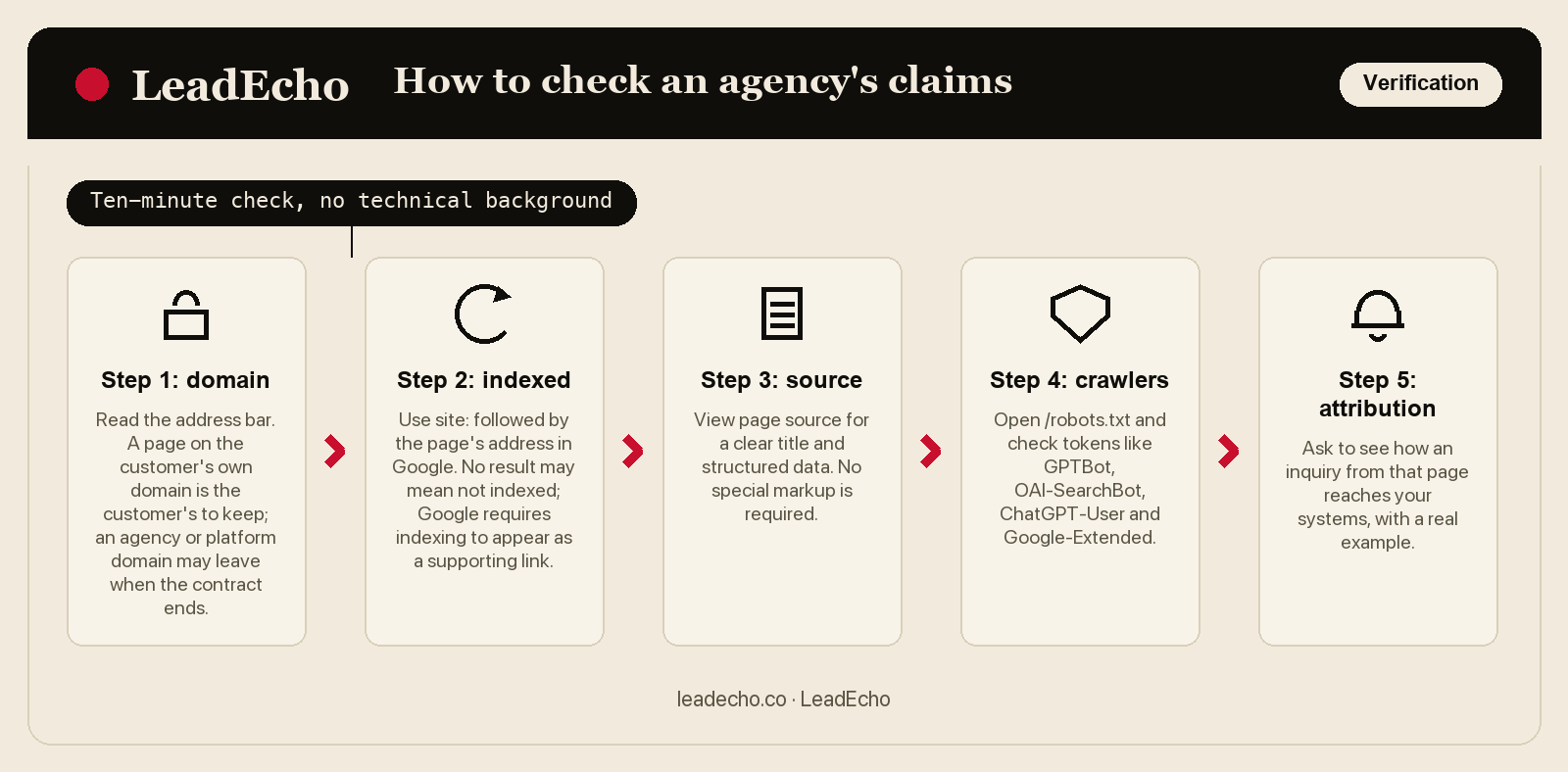
You do not need a technical background for this. You need one live sample page, a browser, and about ten minutes. Ask the agency for a sample page from a current customer’s site, or from its own, then run five checks:
- Domain: Read the address bar. A page on the customer’s own domain is the customer’s to keep, while a page on the agency’s domain or a platform the customer does not control may leave when the contract ends.
- Indexed: Type
site:followed by the page’s address into Google. If nothing comes back, the page may not be indexed, and Google says a page must be indexed to appear as a supporting link. A page that went live last week may simply need time. - Source: Right-click the page, choose View page source, and look for a clear title and structured data. Google says no special markup is required, so treat missing structured data as a question to ask, not a failure.
- Crawlers: Open the site’s
/robots.txtand see which bots are allowed. OpenAI documents GPTBot, OAI-SearchBot and ChatGPT-User as separate robots.txt tokens, and a site must allow OAI-SearchBot to appear in OpenAI’s search surfaces. Google documents Google-Extended as the token that controls access for Gemini apps and Vertex AI. - Attribution: Ask the agency to show how an inquiry from that page reaches your systems, with a real example.
A page that fails step 1 or step 2 is the clearest warning. It means the thing you are paying for either is not yours or is not visible to the engines.
LeadEcho’s own site is one you can run these checks on. Its industry pages ship BreadcrumbList and Service JSON-LD, the site carries an Organization node throughout, and there is a public llms.txt. The robots.txt allows GPTBot, ChatGPT-User, PerplexityBot, ClaudeBot and Google-Extended, and all of it is visible in source.
Before you talk to any agency, find out where you stand today. Run the free AI Visibility Audit on your own URL, and you will have a baseline to hold every vendor’s numbers against.
Once you know what to check and where you start, one fair question is left: are the tools you may already have worthless?
Where a dashboard helps, and where pages take over
A tracking dashboard is useful for measuring where you stand. It just does not change where you stand. It can tell you which of your buyers’ questions name someone else, and only a page can put your name there.
If you already pay an agency, run the five checks above on the pages you have been given. The answer tells you whether you own a publishing program or a reporting habit.
Be clear about what pages will not do. AI search does not decide “who is near me,” because Google’s local pack does, and reviews and your business profile drive that. What it decides is the 20 to 50 research questions a buyer asks before that search, and those are the ones a page can win.
Then set the timeline honestly. With LeadEcho, pages go live in the first 30 days, engines need 30 to 60 more days to crawl and cite them, and first qualified leads typically land in 60 to 90 days. The pace is Google’s, not the vendor’s, which is worth remembering when a pitch promises a date.
Given that wait, terms matter. LeadEcho publishes pages on your own website for ChatGPT, Gemini, Perplexity, Claude and Google AI Overviews to cite, and it is month-to-month, cancel anytime, with no 6-month contract. It was built by operators who run B2B revenue, and it is not an agency.
Test that against the checklist, or test any other vendor against it. Book a 30-minute call: 30 minutes, no slides, and bring the checklist.
Key takeaways
- The deciding question is whether an agency publishes indexable pages on your own website or only ships a dashboard.
- An engine can name your firm only after it pulls a page that exists and is indexed, so a tracker gives it nothing to use.
- A page-publishing scope of work names live URLs on your domain, a question list you approve, your ownership of the pages, and attribution in your systems.
- You can check a sample page yourself: whose domain it is on, whether Google has indexed it, what its source shows, and which crawlers its robots.txt allows.
- A dashboard measures your position and has a real use there, but it never publishes.
- Citations follow published pages on Google’s schedule, and “who is near me” stays with Google’s local pack.